Minstrels and troubadours roamed medieval Europe as its storytellers, musicians, and social commentators. Long before newspapers or broadcast media, these performers carried news, poetry, and music from town to town, court to court. Their legacy stretches across centuries and continues to shape the way we think about performance, poetry, and popular culture today.
Who were the troubadours?
The troubadours emerged in the Occitan-speaking regions of southern France during the late 11th century. Poet-composers by trade, they wrote and performed lyric poetry set to music, often exploring themes of courtly love, chivalry, and political satire. The word "troubadour" derives from the Old Occitan verb trobar, meaning "to find" or "to compose." These were not wandering performers but frequently educated men — and occasionally women, known as trobairitz — attached to aristocratic courts.
The troubadour tradition spread rapidly across Europe. In northern France, the equivalent figures were called trouvères, whilst in German-speaking regions they were known as Minnesingers. Each tradition carried its own conventions and regional character, but all shared a commitment to the art of composed, performed verse. At their height in the 12th and 13th centuries, troubadours held genuine cultural influence, shaping the literary tastes of the nobility and laying the groundwork for much of Western lyric poetry.
The role of minstrels in medieval society
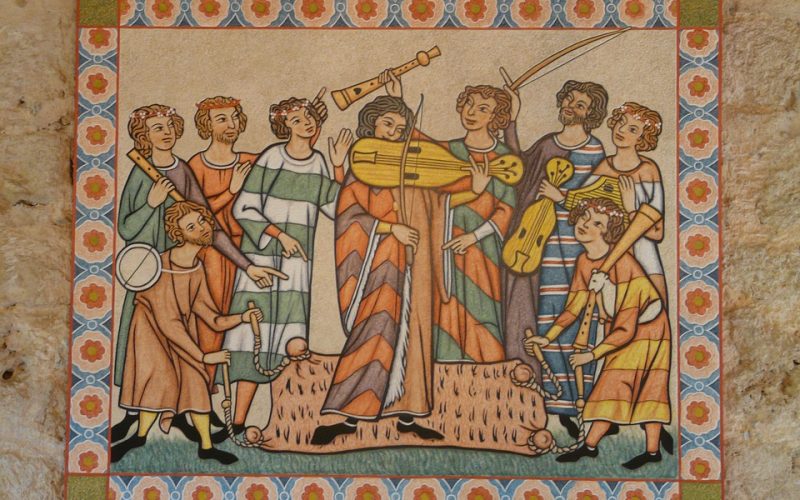
Minstrels occupied a different, though overlapping, place in medieval life. Where troubadours were often composers of original works, minstrels were primarily performers — musicians, singers, and entertainers who played for both aristocratic households and common audiences. The term itself comes from the Old French menestrel, derived from the Latin ministerialis, meaning a servant or official.
A minstrel's repertoire was broad. They performed ballads, romances, comic tales, and instrumental music, adapting their programme to suit the occasion and the audience. At a royal banquet, a minstrel might perform a heroic epic; at a village fair, they might offer something bawdy and comic. This flexibility made them indispensable to medieval entertainment culture. Some minstrels were retained by wealthy patrons and enjoyed relative stability; others travelled between engagements, dependent on the generosity of their audiences.
A tradition under pressure
By the late medieval period, both minstrels and troubadours faced mounting challenges. The Albigensian Crusade in the early 13th century devastated the Occitan courts that had sustained troubadour culture, scattering its practitioners and disrupting the patronage networks they depended upon. The tradition did not disappear overnight, but its vitality gradually diminished.
Minstrels, too, found their status increasingly precarious. As the Renaissance took hold across Europe, tastes shifted and new forms of entertainment emerged. Professional theatre, printed books, and more formal musical institutions began to replace the itinerant performer. In England, legislation such as the Vagabonds Act of 1572 grouped unlicensed minstrels alongside beggars and vagrants, reflecting a broader social suspicion of those who lived outside settled occupations.
An enduring legacy
Despite their decline, the influence of minstrels and troubadours runs deep. The courtly love tradition pioneered by the troubadours fed directly into Renaissance poetry and, eventually, the Romantic movement. Figures such as Dante, Petrarch, and Chaucer all drew on the conventions these medieval poet-composers had established. The minstrel tradition, meanwhile, contributed to the development of the ballad form, folk music, and popular storytelling — threads that remain visible in contemporary songwriting and performance.
The image of the wandering singer-poet has proved remarkably durable in the cultural imagination. From Shakespeare's jesters to the folk revival of the 20th century, the archetype persists. These medieval performers remind us that the desire to make meaning through music and verse is not a modern invention — it is one of the oldest impulses in human culture.